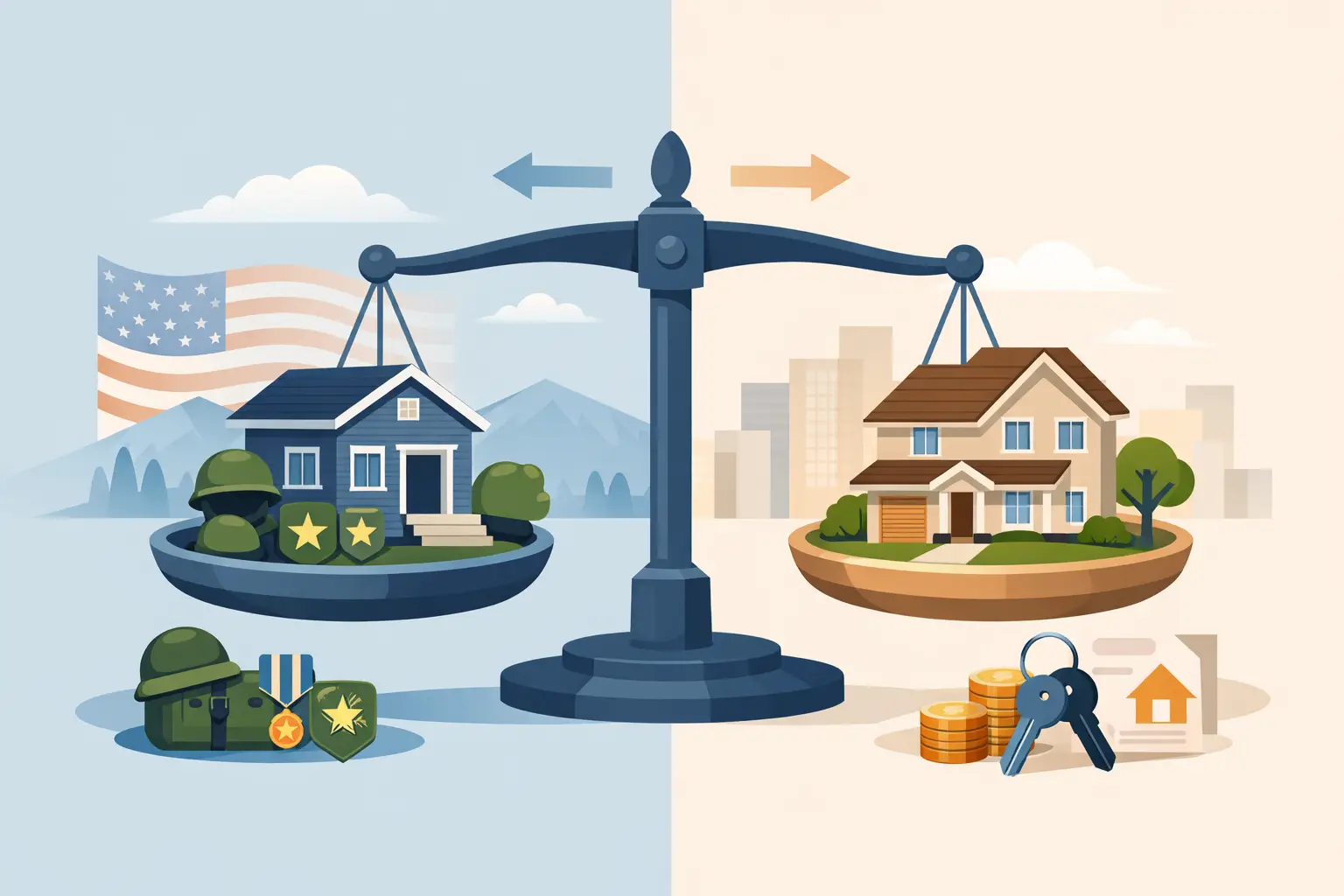
If you’re weighing a va loan vs conventional mortgage, the biggest question usually is not which loan is better on paper. It’s which one puts you in the strongest position to buy now, keep your payment manageable, and move through closing without surprises.
For many eligible veterans, active-duty service members, and some surviving spouses, a VA loan can be one of the most powerful home financing options available. For other borrowers, a conventional loan may offer more flexibility, especially if they have strong credit, solid savings, or a specific property and long-term plan in mind. The right answer depends on your eligibility, your monthly budget, and how you want to use your cash.
VA loan vs conventional: The core difference
A VA loan is backed by the Department of Veterans Affairs and available only to eligible borrowers. A conventional loan is not government-backed and follows guidelines set by Fannie Mae and Freddie Mac or private lenders.
That one difference affects almost everything else. VA loans are designed to make homeownership more accessible for those who qualify, often with no down payment and no monthly mortgage insurance. Conventional loans rely more heavily on the borrower’s credit profile, down payment, and overall risk picture.
Neither option is automatically the winner. A VA loan can create a lower barrier to entry. A conventional loan can be the better fit when a borrower wants to avoid the VA funding fee, has a larger down payment, or is buying under terms that line up more cleanly with conventional guidelines.
Down payment and cash to close
This is where many borrowers first notice a meaningful gap.
A VA loan can allow 100 percent financing, which means no down payment is required for qualified buyers in many situations. That can be a major advantage if you want to preserve savings for reserves, moving costs, repairs, or furnishing a new home. In a higher-cost market, keeping cash on hand can matter just as much as getting a competitive rate.
A conventional loan can require as little as 3 percent down for some first-time buyers, though many programs call for 5 percent or more. If you put down less than 20 percent, you will typically pay private mortgage insurance, known as PMI.
So if cash is tight, the VA loan often stands out. If you already have substantial savings and want to structure the loan differently, conventional may still make sense.
Monthly payment: not just rate, but the full picture
Borrowers often focus on the interest rate first, and that’s understandable. But in a true va loan vs conventional comparison, the full monthly payment matters more than rate alone.
VA loans often come with competitive interest rates and no monthly mortgage insurance. That combination can create a noticeably lower monthly payment, especially when compared with a conventional loan with a small down payment and PMI.
Conventional loans may still be attractive for borrowers with excellent credit and strong financial profiles. In some scenarios, the pricing can be very competitive. And once a borrower reaches 20 percent equity, PMI is not part of the picture.
There is one important trade-off with VA financing: the VA funding fee. This is an upfront cost charged on many VA loans, although some borrowers are exempt due to service-connected disability status or other qualifying factors. The fee can be paid at closing or rolled into the loan amount, but either way it should be part of the decision.
A lower monthly payment today may still come with higher financed costs upfront. That does not make the VA loan a bad deal. It just means the comparison should be done carefully.
Credit score and underwriting flexibility
Conventional financing tends to reward strong credit more directly. The higher your credit score, the better your pricing and loan terms are likely to be. If your credit is excellent, a conventional loan can become very appealing.
VA loans are often more forgiving when it comes to credit and overall underwriting. That does not mean approval is automatic, but it can mean more flexibility for borrowers who have solid income and acceptable overall qualifications, even if their profile is not perfect.
This matters for buyers who are recovering from a financial setback, managing higher debt, or entering the market sooner than they expected. A loan program that looks stricter on paper can still work if the borrower’s full picture is strong. The key is reviewing the file early and knowing where potential issues may show up before you’re under contract.
Mortgage insurance vs funding fee
One of the clearest differences between VA and conventional loans is how each handles lender risk.
With a conventional loan, if you put down less than 20 percent, you usually pay PMI. That cost is added to your monthly housing payment and can stay in place until you build enough equity to remove it.
With a VA loan, there is no monthly mortgage insurance. Instead, many borrowers pay the VA funding fee once, either out of pocket or by financing it into the loan.
Which is better depends on how long you plan to keep the home and how much cash you want to use now. If you expect to stay in the home for years, avoiding monthly PMI can be a major benefit. If you have a large down payment or expect to remove PMI quickly on a conventional loan, the math can shift.
Property standards and appraisal expectations
A VA loan is built for primary residences and comes with specific property requirements. The home must generally be safe, sound, and sanitary. In many cases, this is not a problem. But if the property has condition issues, the VA appraisal process may raise them.
Conventional financing can sometimes be more flexible depending on the property and the transaction. That can matter if you are buying a fixer, competing in a very fast-moving market, or purchasing a home with condition concerns that need to be addressed after closing.
This does not mean VA appraisals are something to fear. It means buyers should understand the type of home they are pursuing. A clean, well-maintained property can move smoothly with either loan type. A distressed property may create more friction under VA guidelines.
Sellers, negotiations, and market competitiveness
Some buyers worry that using a VA loan will make their offer weaker. In some markets, that concern is overstated. What sellers usually care about most is whether the buyer is qualified, the timeline is realistic, and the lender can perform.
That said, local market conditions matter. In a highly competitive Southern California market, a strong pre-approval, responsive communication, and fast underwriting can make a real difference no matter which loan product you choose. Execution matters.
A well-structured VA loan with a reliable mortgage partner can compete very effectively. A conventional loan may still appeal to some sellers because it is familiar and can be perceived as simpler. The best way to overcome that is not by guessing. It’s by having your financing reviewed upfront so your offer is backed by clarity and confidence.
When a VA loan usually makes more sense
A VA loan often stands out when you are eligible, want to buy with little or no down payment, and want to keep your monthly payment as low as possible. It can also be a strong choice when preserving cash matters more than avoiding an upfront funding fee.
It is especially useful for first-time buyers who qualify through military service and do not want to wait years to save a large down payment. It can also be attractive for move-up buyers who want to hold onto liquidity instead of tying up cash in the purchase.
When a conventional loan may be the better move
A conventional loan can be a smart fit if you have strong credit, a meaningful down payment, and a strategy that makes PMI temporary or irrelevant. It may also be worth a closer look if you are not exempt from the VA funding fee and the numbers favor conventional over the time you expect to own the home.
It can also be the better option if the property type or condition lines up more easily with conventional guidelines, or if you are a borrower who prefers the flexibility conventional financing can offer in certain scenarios.
How to choose without second-guessing yourself
The most practical way to compare a va loan vs conventional mortgage is to stop looking at just one number. Review the rate, monthly payment, cash to close, funding fee or PMI, and your expected time in the home. Then look at how each option supports your bigger goal.
If your priority is buying sooner with less cash out of pocket, VA financing may be the stronger path. If your priority is minimizing total long-term cost and you have the financial profile to support it, conventional may come out ahead.
This is where personalized guidance matters. A clear side-by-side review can show you which option serves your budget today without creating regret later. At In Vision Mortgage, that means a transparent process, fast answers, and financing guidance built around the way you actually buy – not a one-size-fits-all recommendation.
The best mortgage is the one that fits your life as comfortably as it fits the loan guidelines.